



Living Quarters Horse Trailer Weight Guide: Truck & Towing Tips
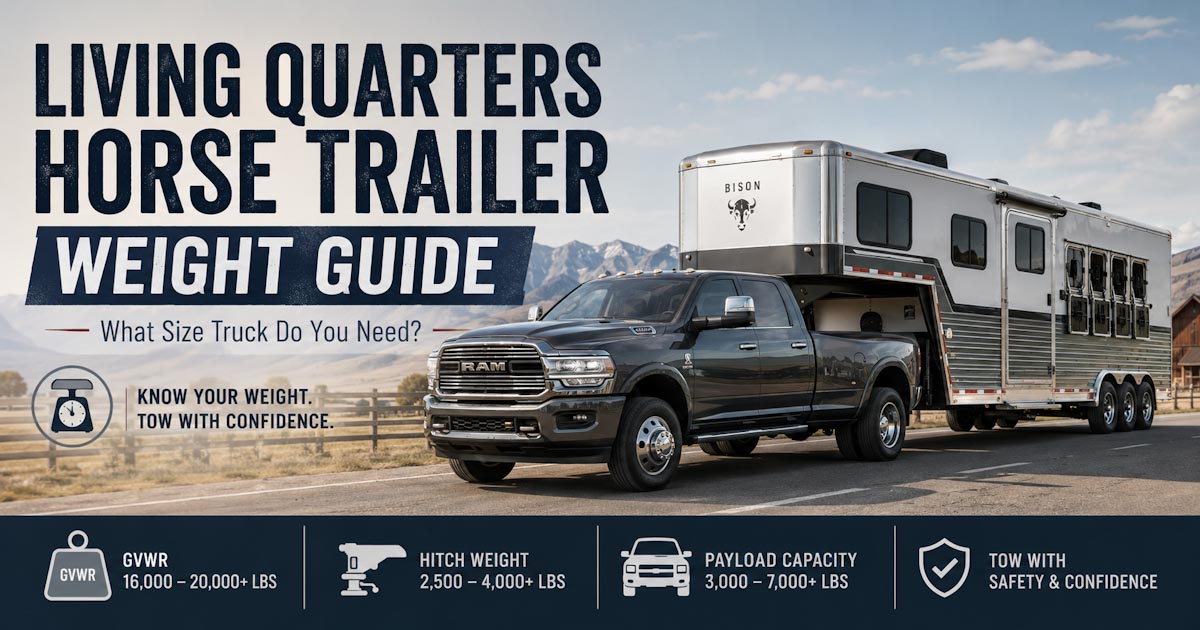
Living quarters horse trailer weight is one of the most important things to understand before buying.
It is also one of the easiest things to underestimate.
A living quarters horse trailer is not just a horse trailer. It is also a camper. That means you are hauling horses, tack, hay, feed, water, appliances, cabinets, plumbing, holding tanks, batteries, air conditioning, sometimes a generator, and all the personal gear that comes with traveling.
That weight adds up fast.
The biggest mistake buyers make is asking:
“Can my truck pull it?”
That question is too simple.
The better questions are:
- Can my truck safely stop it?
- Can my truck handle the loaded weight?
- Can my truck handle the pin weight?
- Am I within payload capacity?
- Am I within rear axle rating?
- Are the trailer tires and axles rated for the load?
- Is the hitch rated correctly?
- What does the trailer actually weigh when loaded?
This guide explains living quarters horse trailer weight, GVWR, pin weight, payload, and what size truck you may need before buying.
Looking for current options? Browse our listings here:
Living Quarters Horse Trailers for Sale
Why Living Quarters Horse Trailers Are So Heavy
A standard horse trailer may only include the horse area, dressing room, tack storage, and basic trailer components.
A living quarters horse trailer adds RV-style features such as:
- Bed
- Bathroom
- Shower
- Toilet
- Kitchenette
- Refrigerator
- Microwave
- Cooktop
- Sink
- Cabinets
- Sofa or dinette
- Water tanks
- Water heater
- Holding tanks
- Air conditioning
- Heat
- Generator or generator prep
- Batteries
- Shore power system
- Awning
- Slide-out, if equipped
Then you still have the horse trailer side:
- Horse stalls
- Dividers
- Mats
- Rear tack
- Saddle racks
- Bridle hooks
- Mangers
- Hay rack
- Fans
- Windows
- Ramps or rear doors
- Axles
- Tires
- Brakes
- Frame
- Roof
- Hitch
That is why a living quarters horse trailer can weigh much more than a basic horse trailer with the same number of stalls.
A 3-horse living quarters trailer is not just a “3-horse trailer.” It is a 3-horse trailer plus a small RV.
Average Living Quarters Horse Trailer Weight
Living quarters horse trailer weight varies heavily by brand, length, construction, number of stalls, living quarters size, options, and condition.
A compact 2-horse LQ trailer with a small weekend package may be much lighter than a luxury 2-horse with a larger short wall, full bathroom, generator, and slide-out.
A 3-horse or 4-horse trailer can also vary by thousands of pounds depending on whether it has mangers, hay rack, generator, rear tack, full living quarters, and added equipment.
Still, here are general weight ranges buyers may see:
| Trailer Type | General Empty Weight Range | General Loaded Weight Consideration |
|---|---|---|
| 2-Horse Living Quarters Trailer | Often around 6,500–8,500 lbs empty | Can exceed 10,000 lbs loaded |
| 3-Horse Living Quarters Trailer | Often around 8,000–10,000 lbs empty | Can exceed 12,000 lbs loaded |
| 4-Horse Living Quarters Trailer | Often higher than 3-horse models | Can become very heavy when fully loaded |
These are general ranges, not guarantees.
Never buy based only on average weight. You need the actual trailer’s weight sticker, GVWR, axle ratings, tire ratings, cargo capacity, and preferably a scale weight.
Empty Weight vs Loaded Weight
Empty weight is useful, but it does not tell the full story.
A trailer may seem manageable when empty, but you do not haul it empty. You haul it with horses, water, tack, hay, feed, people’s gear, tools, and supplies.
Common items that add weight include:
- Horses
- Saddles
- Saddle pads
- Bridles
- Grooming supplies
- Feed
- Hay
- Water
- Buckets
- Blankets
- Show clothes
- Tools
- Spare parts
- Camping chairs
- Food
- Generator fuel
- Propane
- Batteries
- Personal luggage
- Portable panels
- Extension cords
- Water hoses
- Sewer hoses
A single horse may weigh around 1,000 to 1,300 pounds or more depending on breed and size. Three or four horses can add thousands of pounds before you even count tack, feed, water, and supplies.
This is why loaded weight matters more than empty weight.
Important Trailer Weight Terms
Before buying a living quarters horse trailer, you need to understand the basic weight terms.
Empty Weight
Empty weight is the weight of the trailer without horses, water, feed, tack, or cargo.
This may also be called dry weight.
Be careful with this number. It may not include every option added after manufacturing.
GVWR
GVWR stands for Gross Vehicle Weight Rating.
This is the maximum total weight the trailer is rated to weigh when fully loaded.
GVWR includes:
- Trailer
- Horses
- Tack
- Feed
- Hay
- Water
- Living quarters supplies
- Cargo
- Installed equipment
If the trailer’s GVWR is 14,000 pounds, that does not mean the trailer weighs 14,000 pounds empty. It means the loaded trailer should not exceed 14,000 pounds.
GAWR
GAWR stands for Gross Axle Weight Rating.
This is the maximum weight each axle is rated to carry.
A trailer may have two or three axles, and each axle has a rating. You need to know whether the axles are rated for the way the trailer will actually be loaded.
Cargo Carrying Capacity
Cargo carrying capacity is how much weight you can add to the empty trailer before reaching the GVWR.
This is one of the most important numbers on a living quarters horse trailer.
A trailer can look big and still have less available cargo capacity than expected once the living quarters, tanks, appliances, and options are included.
Pin Weight
Pin weight is the amount of gooseneck trailer weight carried in the bed of the truck.
This matters because pin weight counts against the truck’s payload capacity and rear axle rating.
Many buyers only look at towing capacity. That is a mistake.
With living quarters trailers, payload and rear axle rating can become the limiting factor before towing capacity does.
Payload Capacity
Payload capacity is how much weight the truck can carry.
Payload includes:
- Driver
- Passengers
- Tools
- Fuel
- Cargo in the truck
- Hitch equipment
- Gooseneck pin weight
If the trailer puts heavy pin weight into the truck bed, your truck may run out of payload even if it has enough advertised towing capacity.
GCWR
GCWR stands for Gross Combined Weight Rating.
This is the maximum combined weight of the loaded truck and loaded trailer.
That means:
Loaded truck + loaded trailer = combined weight
You need to stay within this rating too.
Why Towing Capacity Is Not Enough
Truck ads love to brag about towing capacity.
That number is useful, but it is not the only number that matters.
A truck may be rated to tow a certain weight, but still be limited by:
- Payload capacity
- Rear axle rating
- Tire ratings
- Hitch rating
- Brake capacity
- Suspension setup
- Wheelbase
- Truck configuration
- Loaded pin weight
This is especially important with gooseneck living quarters horse trailers because a meaningful amount of trailer weight is carried in the truck bed.
That weight can overload the truck before the trailer ever reaches the advertised tow rating.
So do not ask only:
“Can this truck tow 14,000 pounds?”
Ask:
“Can this specific truck safely carry the pin weight and stay within all ratings when the trailer is fully loaded?”
That is the smarter question.
2-Horse Living Quarters Trailer Weight Considerations
A 2-horse living quarters trailer is usually the lightest LQ option, but that does not mean it is automatically light.
A 2-horse LQ may include a bed, bathroom, kitchenette, tanks, cabinets, air conditioning, awning, and tack storage. Those features add weight.
A compact 2-horse weekend trailer may be manageable for some properly equipped trucks. A larger 2-horse with full living quarters, generator, hay rack, and upgraded features can weigh much more.
A 2-Horse LQ May Be Right If…
- You haul one or two horses
- You want easier towing
- You take shorter trips
- You do not need huge storage
- You want a smaller trailer footprint
- You have limited parking or storage space
Watch Out For…
- Small cargo capacity
- Heavy living quarters options
- Full water tanks
- Generator weight
- Pin weight
- Truck payload limits
Do not assume a 2-horse LQ is safe for your truck just because it only hauls two horses.
3-Horse Living Quarters Trailer Weight Considerations
A 3-horse living quarters trailer is often the best all-around size, but it is also where buyers start underestimating weight.
The third stall adds flexibility, but it also means more trailer, more horse weight, and often more gear.
A 3-horse LQ may be used for:
- Three horses
- Two horses plus gear
- Hay and feed storage
- Family travel
- Longer trips
- Show supplies
- Rodeo gear
That flexibility is useful, but every added item increases weight.
A 3-Horse LQ May Be Right If…
- You haul two or three horses
- You want extra storage
- You travel to shows, rodeos, or trail rides
- You need more room than a 2-horse
- You want broad resale appeal
- You have a properly rated truck
Watch Out For…
- Loaded weight over empty weight
- Payload limitations
- Rear axle limits
- Tire ratings
- Pin weight
- Full water tanks
- Hay and feed weight
- Large short-wall living quarters
A 3-horse LQ can be a great choice, but only if the trailer and truck match.
4-Horse Living Quarters Trailer Weight Considerations
A 4-horse living quarters trailer is built for serious hauling.
This size may be right for trainers, rodeo families, show competitors, large families, and buyers hauling multiple horses. But the weight can climb quickly.
A 4-horse LQ may include:
- Four horse stalls
- Larger living quarters
- More tack storage
- Hay rack
- Mangers
- Generator
- Slide-out
- Larger tanks
- More cabinets
- More gear
That can create a heavy loaded trailer.
A 4-Horse LQ May Be Right If…
- You regularly haul three or four horses
- You travel with family or clients
- You need maximum storage
- You compete often
- You take long trips
- You have the right truck
- You are comfortable handling a larger rig
Watch Out For…
- High loaded weight
- Heavy pin weight
- Need for a stronger truck
- Higher tire and brake costs
- More maintenance
- Larger turning radius
- Harder parking and storage
- Greater fuel use
A 4-horse living quarters trailer is not the size to buy because it looks impressive. Buy it only if you need the capacity and can safely tow it.
What Size Truck Do You Need for a Living Quarters Horse Trailer?
There is no single answer because truck ratings vary by year, engine, axle ratio, cab style, bed length, drivetrain, hitch, tires, and options.
Two trucks with the same badge can have very different ratings.
For example, one three-quarter-ton truck may have a much different payload rating than another three-quarter-ton truck depending on configuration.
You need to check the ratings for your actual truck, not just the model name.
Half-Ton Trucks
Be very cautious with half-ton trucks and living quarters horse trailers.
Some small trailers may fall within certain half-ton ratings on paper, but living quarters trailers can create payload and stability problems quickly.
A half-ton may not be the right choice once you add:
- Gooseneck pin weight
- Horses
- Water
- Tack
- Feed
- Hay
- Passengers
- Truck cargo
If you are looking at a true living quarters trailer, especially a 3-horse or larger, a half-ton truck is often not the tool for the job.
Three-Quarter-Ton Trucks
A properly equipped three-quarter-ton truck may work for some living quarters horse trailers, especially smaller 2-horse or certain 3-horse models.
But do not assume every three-quarter-ton truck can safely handle every 3-horse LQ.
Check:
- Payload rating
- Rear axle rating
- Towing capacity
- GCWR
- Tire ratings
- Hitch rating
- Trailer loaded weight
- Pin weight
This is where buyers get sloppy. “It’s a 2500” or “It’s an F-250” is not enough information.
One-Ton Single Rear Wheel Trucks
A one-ton single rear wheel truck can be a stronger option for many living quarters horse trailers. It may offer better payload and towing ratings than many three-quarter-ton trucks.
Still, you need to check the actual truck’s door sticker, rear axle rating, tire rating, hitch rating, and combined weight rating.
A one-ton badge does not automatically make every trailer safe.
One-Ton Dually Trucks
A one-ton dually is often a better match for heavier living quarters trailers, especially larger 3-horse and 4-horse models.
Advantages may include:
- Higher payload capacity
- Better rear stability
- More tire capacity
- Better control with heavier pin weight
- More confidence with larger trailers
If you are buying a large 4-horse LQ, a dually may be the more appropriate truck.
How to Estimate Loaded Trailer Weight
The safest way is to weigh the trailer on a scale.
But before that, you can estimate by adding the major weight categories.
Start with:
Empty trailer weight
Then add:
- Horses
- Water
- Hay
- Feed
- Tack
- Tools
- Generator fuel
- Propane
- Personal gear
- Camping supplies
- Show supplies
Example:
If a trailer weighs 9,000 pounds empty and you add three horses, tack, water, hay, feed, and gear, the loaded weight can climb quickly.
That is why a trailer that sounds reasonable empty may become too much trailer when loaded.
Do Water Tanks Really Matter?
Yes.
Water is heavy. A full fresh water tank can add significant weight.
Living quarters trailers may also carry gray water and black water depending on use.
Before a trip, consider:
- Fresh water tank capacity
- Gray water tank capacity
- Black water tank capacity
- Whether you travel with tanks full or empty
- Where the tanks are located
- How tank weight affects balance
If you are close to your truck or trailer limits, water weight matters.
Pin Weight Can Be the Hidden Problem
Pin weight is one of the biggest issues with gooseneck living quarters trailers.
A gooseneck trailer transfers part of its weight into the truck bed. That weight may help with towing stability, but it also counts against the truck’s payload and rear axle rating.
This is where advertised towing capacity can fool you.
Your truck might be rated to pull the trailer’s weight, but not rated to carry the trailer’s pin weight once passengers, hitch, tools, and cargo are included.
Before buying, ask:
- What is the estimated pin weight?
- Has the pin weight been measured?
- What is the truck’s payload capacity?
- What is the rear axle rating?
- What is the rear tire load rating?
- How much cargo will be in the truck?
Do not ignore pin weight. It can be the number that kills the deal.
Questions to Ask Before Buying
Before buying a living quarters horse trailer, ask the seller these questions:
Trailer Weight Questions
- What is the empty weight?
- What is the GVWR?
- What is the cargo carrying capacity?
- What are the axle ratings?
- What are the tire load ratings?
- What is the estimated pin weight?
- Has the trailer been weighed on a scale?
- Is the weight sticker readable?
- Has anything been added after manufacture?
- Does it have a generator?
- Does it have a slide-out?
- Does it have a hay rack?
- Does it have mangers?
- How large are the water tanks?
Truck Compatibility Questions
- What truck was used to haul it?
- Was the trailer hauled loaded or empty?
- How many horses were normally hauled?
- Did the seller ever weigh the loaded setup?
- Were there any towing issues?
- Did the trailer sway, bounce, or push the truck?
- Were the brakes serviced regularly?
- What hitch setup was used?
Safety and Maintenance Questions
- When were the tires manufactured?
- When were the bearings last serviced?
- When were the brakes last checked?
- Do all lights work?
- Does the breakaway system work?
- Are the axles straight?
- Is there uneven tire wear?
- Has the trailer ever been overloaded?
- Has the trailer been in an accident?
If the seller cannot answer basic weight and maintenance questions, slow down.
That does not automatically mean the trailer is bad, but it does mean you need to inspect carefully.
Do Not Forget Trailer Brakes
A truck does not stop a loaded living quarters horse trailer by itself. Trailer brakes matter.
Before buying or towing, confirm:
- Trailer brakes work
- Brake controller works
- Breakaway battery works
- Breakaway switch works
- Wiring is in good condition
- Brake shoes or pads are serviceable
- Drums or rotors are in acceptable condition
- Axles are not damaged
- Bearings have been maintained
A trailer that can be pulled is not automatically safe to stop.
Trailer Tires Matter More Than Buyers Think
Trailer tires are not just round pieces of rubber. They carry the trailer load.
Check:
- Tire age
- Load range
- Size
- Tread
- Sidewall cracking
- Uneven wear
- Inflation pressure
- Matching tires
- Spare tire condition
- Wheel condition
Old trailer tires can look fine and still be unsafe.
If you are buying a used living quarters trailer, tire age and rating should be part of your inspection.
Signs the Trailer May Be Too Much for the Truck
A trailer may be too much for the truck if:
- The rear of the truck squats heavily
- Steering feels light
- Braking feels weak
- The trailer pushes the truck downhill
- The setup feels unstable in wind
- The truck struggles to control the trailer
- Tires are overloaded
- Rear axle rating is exceeded
- Payload rating is exceeded
- GCWR is exceeded
- The hitch is under-rated
- The truck is constantly at its limit
If the setup feels unsafe, it probably is.
Do not let pride make a bad towing decision.
Common Buyer Mistakes
Mistake 1: Looking only at advertised towing capacity
Towing capacity is not enough. Payload, rear axle rating, tire ratings, hitch rating, and pin weight matter too.
Mistake 2: Using empty weight instead of loaded weight
You do not tow the trailer empty. Horses, water, tack, hay, feed, and gear can add thousands of pounds.
Mistake 3: Forgetting about pin weight
Gooseneck trailers put weight into the truck bed. That weight counts against payload.
Mistake 4: Assuming all aluminum trailers are light
Aluminum trailers are often lighter than steel trailers, but living quarters, options, length, and cargo still add weight.
Mistake 5: Buying the trailer before checking the truck
This is backwards. Know what your truck can safely handle before shopping seriously.
Mistake 6: Trusting what someone else towed with
Just because another person hauled the trailer with a certain truck does not mean it was safe, legal, or within ratings.
Mistake 7: Ignoring tires and brakes
Tires and brakes are not small details. They are safety systems.
Simple Buying Rule
If you are close to the truck’s limits on paper, you may be too close in real life.
Ratings do not leave room for guessing, extra gear, full tanks, larger horses, passengers, hills, heat, wind, or emergency braking.
A good towing setup should feel controlled, stable, and properly matched.
Final Recommendation
Living quarters horse trailer weight is not something to guess on.
Before buying, get the actual trailer numbers:
- Empty weight
- GVWR
- Axle ratings
- Tire ratings
- Cargo carrying capacity
- Pin weight if available
Then compare those against your truck’s:
- Towing capacity
- Payload capacity
- Rear axle rating
- Tire ratings
- Hitch rating
- Gross combined weight rating
A smaller 2-horse LQ may be easier to manage, but still needs a properly rated truck.
A 3-horse LQ is often the best all-around trailer, but loaded weight can surprise buyers.
A 4-horse LQ can be a great tool for serious hauling, but it demands serious attention to truck capacity, braking, tires, and maintenance.
The right trailer is not just the one your truck can move.
It is the one your truck can safely carry, control, and stop when fully loaded.
Ready to compare actual trailers?
Browse Living Quarters Horse Trailers for Sale
Frequently Asked Questions
How much does a living quarters horse trailer weigh?
Living quarters horse trailer weight varies by size, brand, length, construction, and options. Many 2-horse LQ trailers may weigh around 6,500–8,500 pounds empty, while many 3-horse LQ trailers may weigh around 8,000–10,000 pounds empty. Loaded weight can be much higher once horses, water, tack, feed, hay, and gear are added.
How much does a 2-horse living quarters trailer weigh?
A 2-horse living quarters trailer may weigh around 6,500–8,500 pounds empty depending on construction, length, and options. Loaded weight can exceed 10,000 pounds after adding horses, water, tack, feed, and supplies.
How much does a 3-horse living quarters trailer weigh?
A 3-horse living quarters trailer may weigh around 8,000–10,000 pounds empty, with loaded weight often exceeding 12,000 pounds depending on horses, water, tack, hay, feed, and gear.
How much does a 4-horse living quarters trailer weigh?
A 4-horse living quarters trailer can be significantly heavier than smaller LQ models. The actual weight depends on length, living quarters size, construction, generator, mangers, hay rack, slide-out, and loaded cargo. Always check the trailer’s actual weight sticker and GVWR.
What size truck do I need for a living quarters horse trailer?
It depends on the specific trailer and truck. Many living quarters horse trailers require a properly equipped heavy-duty truck. Smaller 2-horse models may work with some properly rated trucks, while larger 3-horse and 4-horse trailers often require a three-quarter-ton or one-ton truck. Heavier trailers may be better matched with a one-ton dually.
Can a half-ton truck pull a living quarters horse trailer?
Be very cautious. Some small trailers may fall within certain half-ton ratings on paper, but payload, pin weight, rear axle rating, and braking can become major problems. Many living quarters horse trailers are better matched with heavy-duty trucks.
Is towing capacity the same as payload?
No. Towing capacity is how much weight the truck is rated to pull. Payload is how much weight the truck is rated to carry. Gooseneck pin weight counts against payload, which is why payload can become the limiting factor.
What is pin weight on a horse trailer?
Pin weight is the amount of gooseneck trailer weight carried in the truck bed. It affects payload capacity, rear axle rating, rear tire load, and overall truck stability.
What is GVWR on a horse trailer?
GVWR stands for Gross Vehicle Weight Rating. It is the maximum total weight the trailer is rated to weigh when fully loaded, including the trailer, horses, tack, water, feed, hay, and cargo.
Should I weigh my horse trailer?
Yes. A scale weight is one of the best ways to know what your trailer actually weighs. If possible, weigh the trailer loaded the way you normally travel.